


Melody is a new focused research organization that is developing public goods (tools, standards, and devices) to catalyze the field of continuous monitoring. We’re so excited to publicly launch Melody FRO today!
At Melody, we believe time resolution is a major bottleneck in advancing human physiology; we leverage protein engineering and device design to create new tools to solve this problem.
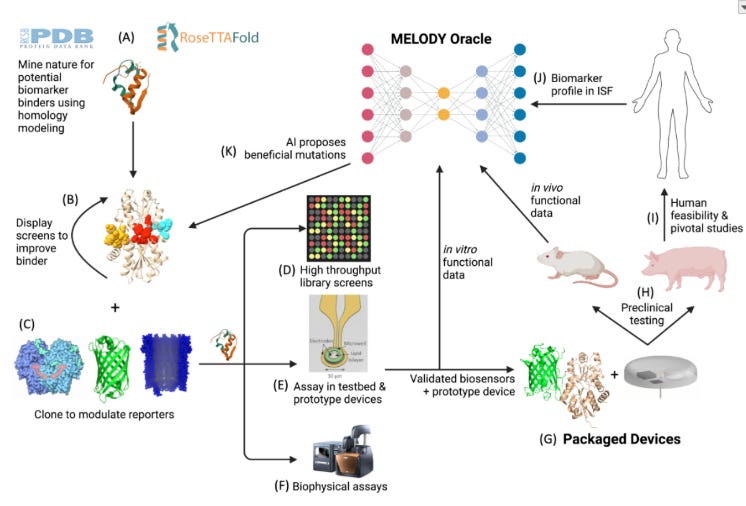
Thanks to our generous funders and our non-profit mission, we can share the materials we produce openly and advance new devices as scientific tools for human research well before there is a clear-cut market case. We work to bring a common engineering platform to biosensing and devices (Figure 1). This model enables open-source tools for greater user control, securing a desirable future of devices.
In this essay, I’ll describe where Melody comes from and where we’re going. I hope you’ll join us.
Prologue: desiring machines
A loop began millions of years ago that made us human: tool-making, cooperation, and the sharing of resources across generations coevolved with a long childhood (i.e., extended brain development) and more complex rituals. Over thousands of generations, each reinforced the others: better tools and coordination grew the resources available to support extended development which, in turn, improved the capacity to learn increasingly complex skills and social functions.
Fast forward to today: that loop is tighter. We now have tools to alter our physiology within a lifetime, by targeting the biological circuits that shape our behavior and experience. We are truly a species that builds the strata that build us. Increasingly, the ability to edit biology outpaces our understanding of the consequences, requiring better tools to capture and analyze those effects on the right time scales.
But even if we understood the effect that a particular perturbation has on human physiology, we have an even bigger question we need to answer: which effects do we want? Regulatory infrastructure addresses safety, but does not settle questions of goals and desirability. Furthermore, drugs that “repair” can easily blur into “enhancement.” There are increasingly many goals and tradeoffs to choose from (e.g., time under stimulation vs. rest), and everyone chooses interventions and is affected by their choices differently.
Tools are proliferating: wearables, injectables, peptides, prescriptions, smart drugs, imaging tools, and smartphones. New measurement modalities hold the promise of abundant observations but will need stronger footing to make clinical claims. AI models will accelerate the development of all of these modalities and how they are used, and produce new human-machine interface possibilities at the edge of our current imaginations.
These new tools bring new challenges. I believe that, as biological tool-makers, we are always responsible for understanding the decisions that our new tools enable and the consequences that befall people when they don’t work. We are responsible for wisely stewarding the data we collect to build that understanding. These data are materially as personal as it gets; how these tools collect and use data (that is, the standards we create) can protect or, conversely, erode privacy and autonomy across our species. We need a renewed ethos at this new moment of possibility, one that takes advantage of new measurement and development tools, combines explicit and generalizable safety safeguards with individual control over goals and tradeoffs, and delivers material improvements for each individual. Melody exists to further that ethos with tangible public goods, to help bring about a new practice of cybernetics for the world of biosensors and health.
Cybernetics as ethos and practice
Why look to an 80+ year old field in 2026?
As we create increasingly powerful intelligences, we must ask how we should use them or allow them to interact with biotechnology. Better, more recent models of physiology may have higher predictive accuracy, but do not incorporate the focus on human agency and steering that motivated the early cyberneticists. We have much to learn from them.
Cybernetics studies how living organisms and machines use feedback to regulate their behavior, offering a quantitative framework for connecting goals, measurements, and adjustments to actions as conditions change. Critically, cybernetics, from its foundational paper, made telos (purpose) an explicit part of its practice. In fact, in 1960, Norbert Wiener wrote, “we had better be quite sure that the purpose put into the machine is the purpose which we really desire.” Many fields that emerged from cybernetics have maintained this ethos, but others have not benefited as much from their intellectual inheritance.
Who should decide where new biocapabilities take us? My working concept is that because physiology varies and people bear the consequences, they should guide the goals of their interventions and control their data, while shared tools and voluntary experiments help build the scientific corpus:
Humans share similar biology but have highly variable physiological and behavioral dynamics.
We share an ability to exercise our will, but we have vastly different goals.
We introspect, plan, make tradeoffs, and, most human of all, develop rituals to set a cadence.
We are desiring machines and there is a deep satisfaction in moving ably through the world.
Some of our most meaningful goals and rituals are biological and based on trajectories:
I want to train and run a marathon or climb a mountain, beating my personal best.
I want to have a healthy child and be healthy and capable afterward.
I want to live independently into old age and simply enjoy all of my hobbies.
Pursuing these goals takes months or years, all while our bodies and responses to intervention change. Ambitious enhancement of those biological capacities (such as tissue and organ grafts or invasive read/write devices) ventures out of the normal envelope of biological control, to where we have little data or few maps. Where we do not have a sense of the landscape, but still wish to press ahead because of our goals, we need to keep our compass and our wits about us.
Cybernetics is made actionable by control theory’s mathematical tools for modeling states, measuring a response, and optimizing adjustments towards a goal. This process can complement machine learning approaches to estimating and predicting states, especially when drawing on large clinical datasets. Feedback processes let a system (e.g., drug pump, cell, clinical decision, etc.) adjust based on an individual’s actual response. Hard-coding user control over goals and introducing basic guardrails then create the beginnings of a “steering technology” that allows personal exploration and optimization.
A concrete example of this ethos and practice in the real world is the Open Artificial Pancreas System project (OpenAPS), a user-led effort that gave users around the world access to connected continuous glucose monitors and insulin pumps through open-source software to automatically adjust insulin delivery. I admire their elevation of the user and track record of safety and rigor when venturing into new protocols. In their own words:
We believe that we can make safe and effective APS technology available more quickly, to more people, rather than just waiting for current APS efforts to complete clinical trials and be FDA-approved and commercialized through traditional processes. And in the process, we believe we can engage the untapped potential of dozens or possibly hundreds of patient innovators and independent researchers and also make APS technology available to hundreds or thousands of people willing to participate as subjects in clinical trials.
OpenAPS was successful in integrating an existing continuous glucose monitor (CGM) and insulin pump paired with a controller and a control algorithm. This open source setup not only brought customizable automated insulin delivery to users faster than the market but also enabled continual improvement. Features like meal handling and target insulin waveforms could be iterated and shared.
Eventually, the CREATE (Community deRivEd AutomaTEd insulin delivery) trial, led by Martin de Bock at the University of Otago with collaborators across New Zealand, tested an open-source automated insulin delivery system using the OpenAPS algorithm in a randomized controlled trial, the first of its kind. The trial showed users with the OpenAPS algorithm had an adjusted 14-percentage-point advantage (3 h, 21 min per day) over the control group which did not have software for automatically adjusting to personalize insulin dosing in terms of time-in-range. Their publication in the New England Journal of Medicine involved clinicians, researchers, and OpenAPS members, a major milestone for normalizing user-led engineering.
Getting grounded: brain-body-behavior dynamics motivate our continuous monitoring
I believe that OpenAPS shows us what could be accomplished more generally when we allow ourselves to experiment with new tools, building up time series data to improve our models of circuits and their inter- and intra-personal variance. But perhaps glucose-insulin homeostasis is a clear-cut case for continuous monitoring given the ~minute-level changes and the depth of hardware and clinical knowledge we have about diabetes and similar conditions. Can we and do we need to generalize this approach further?
I argue we are still in the early innings of systems physiology and need better scientific tools to push further. Here is one simple argument for advancing continuous monitoring: the peripheral nervous system (PNS) senses conditions across organs and relays commands that help regulate them (Figure 2). Along with circulating hormones and local chemical signals, the PNS helps coordinate the body’s responses to meals, exertion, injury, and illness. It mounts responses to all the world throws at us, and keeps us moving through it for the entirety of our lives. Would it not be remarkable if we could one day see what the body’s own sensing systems are seeing?
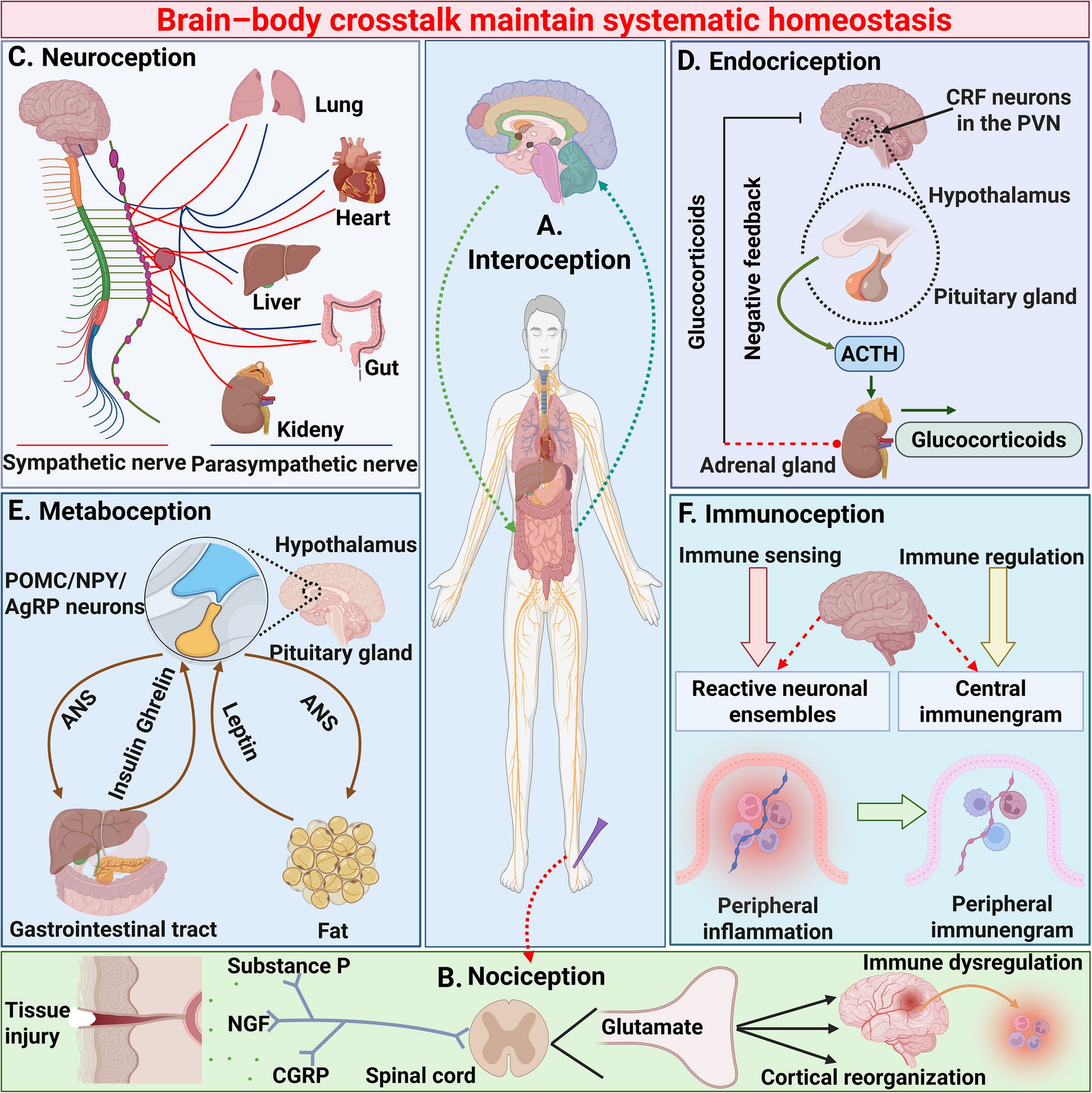
Many of the other phenomena of interest for both science and wellness involve circuits underlying “brain-body-behavior interactions”, where neural activity and organ function cooperate to shape physiological state, and our behavior feeds back to alter both. These interactions pose some of the most challenging problems for traditional pharmaceutical approaches because their underlying circuits have complex temporal features. They:
have time-varying behaviors (tolerance, desensitization, habituation, circadian drift). For example, GLP-1 slows gastric emptying, but the effect can weaken within hours of continuous exposure due to an adaptation phenomenon called tachyphylaxis.
are sensitive to the kinetics of perturbations (i.e., sensitive to waveform shape not just total input). For example, hormone therapies are quite time-sensitive. Take a case in fertility: gonadotropin releasing hormone must be given in a pulsatile fashion to mimic the hypothalamus and stimulate the pituitary gland to release LH and FSH for certain fertility disorders (continuous release has the opposite effect!).
impinge on subjective state and function (e.g., motivation, emotional state, proprioception, and a higher sense of self). Drugs for muscle wasting may need to be paired with physical therapy and may not address reduced motivation (to eat and physically exert oneself).
Many of these challenges are classically considered secondary problems of delivery, pharmacokinetics, adherence, form factor, consumer health needs, etc. We want to elevate these considerations into primary control engineering campaigns for brain-body-behavior interactions. Better sensing technologies and careful perturbation of the body's circuits can improve them.
Enabling better observation and control over waveforms generally may open up research questions and then therapeutic applications in adaptive exercise regimens, restoring circadian rhythm / altering sleep patterns, improved regimens to reduce drug dependence, personal hormone therapy regimens, richer and deeper control of prosthetics including molecularly based BCIs and tissue/organ grafts, and more future enhancements difficult to conceive of today.
Interlude: wandering in the desert of the real
It’s all well and good to dream about new capabilities for humanity. But why do we have so few so far? The hard truth is that the field only has a handful of reliable continuous monitors; few breakthrough devices reach acceptable performance and mass use. This is particularly a problem for enriching our view of human physiology to drive better therapeutic development. We may have picked the low-hanging fruit in conventional preclinical models; there is still a pharma R&D productivity gap driven largely by late-stage clinical failure. Moreover, new therapeutic approaches, especially with new modalities for brain and behavior, will be brutally difficult without better physiological maps. For all the talk of AI in bio, we have limited human data and limited tools to collect more. We walk in the desert of the real.
Still, I am steadfastly optimistic. Over my life, I have seen an oasis of science spring up, and I am confident that we will, with new organizations and approaches, keep it flowing.
My first love in science was in chemical biology, making new building blocks for life. I started the summer after freshman year in James Petersson’s lab. We studied protein dynamics using minimal unnatural amino acid probes in FRET. The idea was simple: making a “motion capture suit” for proteins so that you could watch them fold and unfold rather than just getting a snapshot structure. A powerful lesson was that you could make building blocks never seen by nature but incorporate those blocks using nature’s own machinery - if you learn its rules. Proteins are, well, protean and can be shaped to your desired goals, following learnable principles. Nature has gifted us a great system to elaborate on and apply.
Towards the end of undergrad, I then had either the great gift or curse of great interest in both science and anthropology. At this time, I felt portless in thinking what would come next. I stumbled into a talk by Luke Lavis discussing chemistry at Janelia Farm. I found the name confusing but everything else was crystal clear: use chemistry and physics to make tools to study biology. He described the life of a tool builder in a campus full of driven neuroscientists. It sounded like an incredibly dynamic place to be.
Right before graduation, I found this video of Gerry Rubin on their homepage discussing “a different model for science” - that was my first taste of metascience, experimenting with an organizational model to suit the science of the time. Labs would be kept small, around five or six people, the institute would take long, carefully planned bets without immediate expectation of payoffs, and there would be a healthy mix of all kinds of scientists and engineers. Some built microscopes; others asked the right biological questions with them. Some worked in focused labs; others worked in core facilities. It felt like a breath of fresh air after searching for so long for an intellectual home. I had no idea what Ashburn, VA was going to be like, but I knew I had to move there.
When I got to Janelia, I loved the campus and everyone and everything in it. There was a whole new world of neuroscience to absorb. We had hobby groups in robotics, imaging, and virtual reality with self-driven projects - play was the best learning for a beginner. I focused on synthesis of new chemical probes, again bringing chemistry to bear on biology, opening up what we can observe in living tissues through microscopy. We got to freely share our dyes via Janelia’s Open Science program with scientists all over the world. It’s a special feeling to craft something with your hands and see it appear in a paper from another continent. Some folks really turned an idea into a whole world, and I got to be a small part of it.
After a couple years at Janelia, I was sold on science as a career, shifted from chemistry to biology at Caltech, and dove headfirst into neurobiology with my advisor Henry Lester. First making new sensors, then applying them. Along the way, I did a 180 on animal behavior thanks to John Allman and his course and writing. I thought it was too squishy to study, but then appreciated learning the goals and purpose of a system to give meaning to the rest of its parts. I internalized that The Human Illnesses are indeed uniquely human. Indeed, humans are the best model organism for humans. This lesson led to seeing a clear issue: that the molecular sensing tools we made would not readily be used in humans.
I serendipitously was introduced to Milan Cvitkovic (then strategy lead at Convergent Research) and over coffee he suggested writing a two pager analyzing bottlenecks in the device field. That led to a workshop, which eventually led to an incubation period with Convergent Research. Up until that point, I was not familiar with the FRO model, but learning about it resolved a lot of tensions between organizational incentives and prerequisites for tool development. Well before this, I remember a contingent of us meeting at the Red Door at Caltech and dreaming about what it would be like to make a science institute and do it the right way. It turns out some others were already on it, unbeknownst to us. I fortuitously met David Garrett (Hardware Engineering Lead) at Caltech, and we wrote this technical note linking device bottlenecks to the FRO model as we continued to incubate the project and get public feedback.
A few years later, it’s clearer than ever that building a new research organization is taking on two challenges of engineering and operations at once - without a set formula, strong stewardship is required. It’s rarefied air to do high-risk science and also deliver products at some impactful scale - even more so starting as a new organization. I think one must hold a challenging but necessary duality of mindset. The first side is playfulness, which helps me through any challenge. Science is just fun, and it dissolves hard things and makes it easy to take leaps of faith. I was always excited when my Dad brought home chemicals to experiment with. I loved walking through Westhollow Shell with him, seeing the glass blowing, the pilot plants, the whole campus alive with pure potential. It was electric. The closest feeling I have had to that since was building our new lab with our team.
The other side is an industrial mindset. It’s only partly satisfying to read essays about the decline of industrial R&D and policy proposals to fix it in the abstract. The problem is more visceral and dire than it seems because decline means destruction, and lost capacity is less capacity to rebuild. “We just don’t know how to do it anymore” is a reality in so many fields where we used to be prolific producers. One reason is that hardware projects are often ‘weak link problems’ where each piece has to perform with every other piece, and iteration speed matters to find failure points. All of this gets encoded in culture and mindset too. For me, the visceral point is that Shell, like many orgs, has been cutting R&D, but they also ceased operations in new lab spaces already built! This is the case for many multinational companies today: even with existing, abundant lab square footage, there often isn’t a business model to fill them.
I see now that, in today’s world, it takes far-flung imagination and unwavering persistence to keep this infrastructure alive.
Market failure in scientific tools & devices
In life science today, pharmaceutical companies largely outsource R&D to biotech companies. And, in turn, production of R&D tools is largely outsourced to a small number of tool companies. While tools for human data collection may help guide therapeutics, their value and technical requirements are hard to coordinate across these markets. Only a handful of measurement tools meet the criteria for broad use and scalability (e.g., microscopes, qPCR, and DNA sequencers).
Furthermore, today’s measurement methods must heavily compromise one axis of breadth or time to gain another. Broad molecular profiling still generally forces intermittent sampling, leaving gaps in the physiologically relevant time series. Aside from some imaging and electrophysiology methods, few commercial tools are designed to both observe and control complex systems in real time. They were designed as excellent laboratory tools, and fields have built workflows around this constraint. Mass spectrometry offers broad molecular coverage but requires extensive sample preparation, limiting its use continually outside of the lab. Next-generation sequencing (NGS) provides a broad foundation to convert molecular events or species into nucleic acids for facile sequencing. NGS’s adoption rate benefits from having a “common carrier”, a small number of possible bases to read and a relatively immediate connection to biotechnology R&D efficiency.
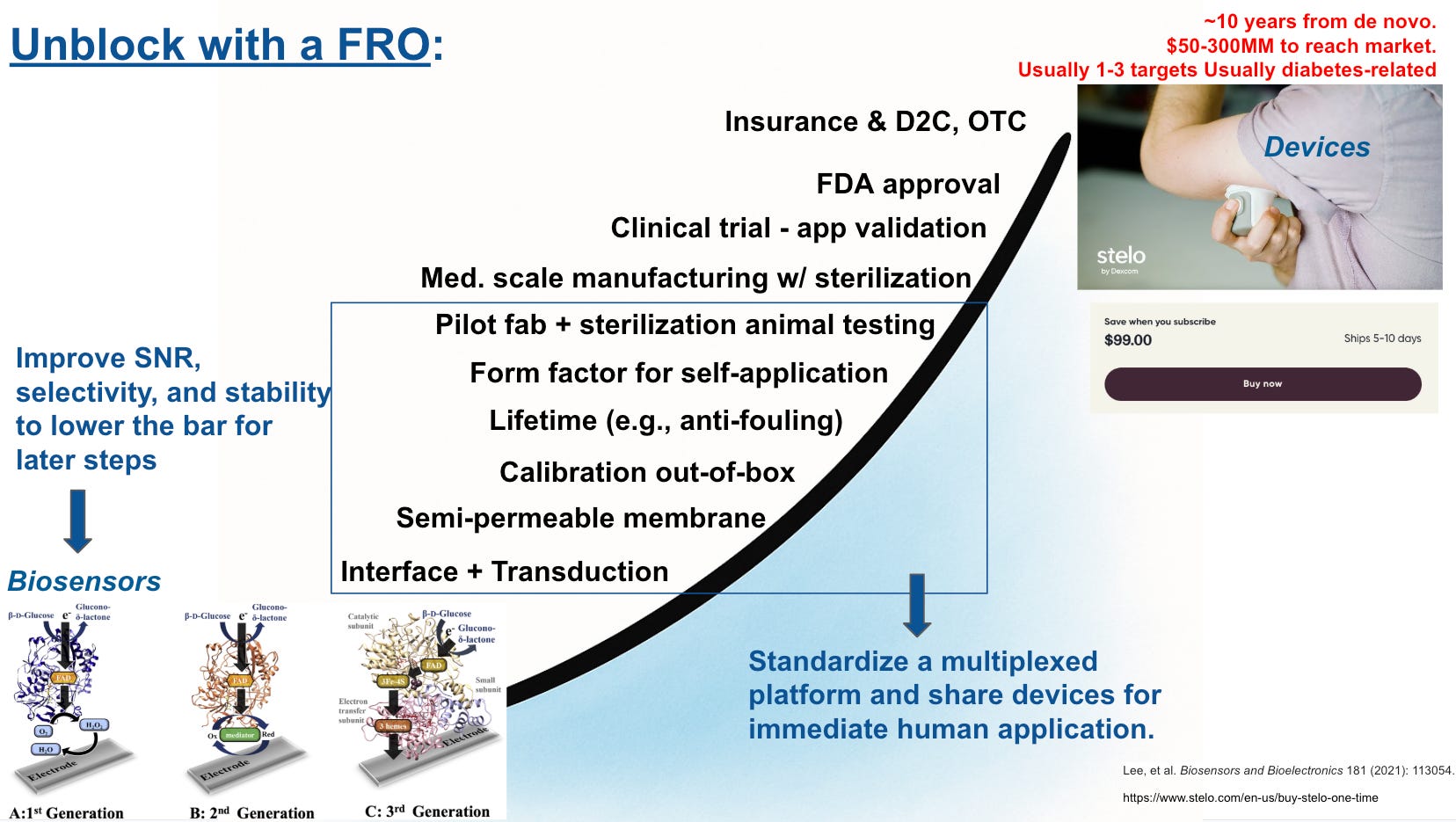
In contrast, biomolecular sensing of ions, small molecules, and proteins does not have a common carrier and measurements in humans have longer times to pay off and introduce severe constraints, requiring new medical devices. The capital intensiveness of device manufacturing means today our scientific tools for humans largely follow market products. There is a chicken-and-egg problem here: companies must follow clear reimbursement paths, largely focusing on diabetes care, working in 5-10 year development cycles (Figure 3). Even if startups pursue cash pay for consumer health applications, they likely will need to pick a beachhead market and focus narrowly to justify manufacturing in later stages. This incentive structure makes platforms difficult to finance: their benefits extend across applications and any one developer captures only part of that value after a decade of development.
The existing toolkit of device-compatible biosensors is underdeveloped and bottlenecked by throughput in molecular engineering. Handheld blood ketone meters were available by 2001, but the FDA authorized the first wearable continuous ketone monitor only in August 2026. Lactate oxidase-based sensors have reached human feasibility testing, with further refinement needed to improve accuracy. Depending on the enzyme and readout, challenges include maintaining enzyme activity, managing oxygen dependence, or supplying and retaining cofactors for dehydrogenases. These requirements interact with membrane design, sensor loading, and calibration, making sustained performance a full integration problem for a team of chemists, biologists, and electrical engineers. Generally, continuous molecular monitoring is limited by reliance on native enzymes, low‑plex bioelectronics, and limited alternative performant reagents. The result is advancing one or a few sensors through a lengthy and costly manufacturing process.
Even with commercial vendors, the incentives and feedback loops are not strong enough to provide verified parts to researchers and industry. Biology at large still struggles with non-specific antibodies, with direct R&D waste estimated at ~$1B/year. I wager there are analogous reproducibility problems for more specialized reagents like biosensors, though they're less well known because of the more niche user base and more complicated biological preparations that convolute results. For example, a review of 780 reports of popularly used aptamers, readily available DNA or RNA switches used in biosensing, found that 41% reported unexplained sequence alterations or omitted sequences, raising concerns around reproducibility. There is a real but age-old standards and coordination problem, and perhaps the biosensor field is ripe for systematizing.
Who will fill the reagent gap? Getting organizational incentives right is one step, but eventually inventing new biosensors and signal transduction mechanisms is needed to make our work feasible. Biosensor reagents must also connect to a readout method that a device can measure. Common strategies are built after the biosensor and must rely on general, but low signal-to-noise readouts. These strategies often rely on redox labels, field-effect transistors, or Förster resonance energy transfer (FRET) so that binding is transduced only indirectly and/or without inherent amplification by the biosensor; the resulting low signal‑to‑noise ratios demand aggressive processing and can lead to artifacts. Indeed, new biosensing chemistry and therefore interfacial materials and hardware need to be developed alongside each other.
Academic labs have led the way in discovering physical phenomena to exploit for sensing and developing proofs of concept. However, even research consortia typically lack a singular, deployable instrument to benchmark their tools let alone the resources to solve manufacturing and scale challenges to make one.
There are a handful of exceptions in preclinical neuroscience thanks to efforts like the BRAIN Initiative and Janelia: Open-Source UCLA Miniscope Project and Neuropixels. In a sense, the goal of a FRO is to similarly recreate the magic of open neuroscience for human physiology while taking on operational challenges (see an excellent blog about this topic).
We see protein engineering as an unlock for continuous monitoring, but the medical device industry largely lacks de novo biosensor generation. So far, protein engineering has served biopharma well in AAV and antibody engineering, where the readout is readily sequenced (thanks to NGS) and clearly tied to a value-generating step (usually improved IP around a delivery vehicle or drug). A key difference for engineering biosensors is that their readout often requires biophysical methods (especially if not using fluorescence) to separate the protein from its DNA, lowering throughput. This is a laboratory instrument and throughput bottleneck that must be taken on as well.
The shape of a biosensing commons
To crack the chicken-and-egg problem, we would need to both invent around bottlenecks and take on more industrial approaches. This problem fits squarely within the focused research organization (FRO) model. And, fortunately, we are far from starting from scratch. We see a technological overhang from the BRAIN Initiative era of neuroscience: protein engineering methods, biosensors with good kinetics, device form factors for multiplexed sensing, and preclinical data that can be marshalled for our efforts in humans. Melody aims to build upon this work to deliver new sensors, testbed instruments, and devices while catalyzing efforts to support an entire biosensing commons consisting of eight pillars:
1. Biomarker quantification - simply put, we have little-to-no longitudinal quantification of most biomarkers in human biofluids other than blood, such as interstitial fluid, sweat, saliva, tears, and cerebrospinal fluid that also carry biomarkers but may have unique signals or allow for more scalable, minimally invasive sampling. But most biomarker characterization to this day focuses on blood/serum, which is often more physiologically relevant and clinically actionable. However, many device projects aim for “noninvasive” or “minimally invasive” form factors, perhaps rightfully avoiding blood sampling (which poses discomfort and infection risk). But we are flying blind because we don’t know which species distribute from blood into interstitial fluid (ISF), with what time lag, and what variance across time and disease states. I contend biomarker validation (and exploratory human studies) are some of the most underrated areas for public goods science (relatedly, see The Case for Clinical Trial Abundance by Ruxandra Teslo and Willy Chertman). Tool makers ought to know what target to hit and what empirical scaling of concentration and waveform to use for their biofluid.
2. Sampling methods and instruments - relatedly, we are hampered in reliably and repeatably sampling these biofluids. Notably, to my knowledge, there is no commercially available interstitial fluid in contrast to many other biofluids. The methods and results in sampling are even more variable when you depart from blood. ISF may be collected by microneedle patches, suction blisters, or reverse iontophoresis - each with a variety of parameters and systematic differences in resulting sample composition. Collecting sweat in meaningful volumes requires exercise or chemical stimulation - again with highly variable results. Saliva and tears are easily contaminated. Researchers need access to reliable collection devices and the field must learn variance across protocols. Scalable approaches to ISF likely point towards microneedle patches. A variety of other properties (e.g., sample turbidity, raw absorbances, particular species count, etc.) could provide some metric of comparability between samples.
3. Protein binders, particularly conformational switches to recognize biomarkers - a library of these switches would convert target binding into useful work that could modulate multiple reporters of interest. The key difference is that antibodies and most binders typically do not undergo large conformational changes (10s of angstroms) or fold-switching to modulate another protein. Additional functional datasets describing linkers that most effectively convey switch motion to some popular reporters would be both practical and interesting for protein function prediction problems. Device makers ought to have a library of molecular reagents that could reliably connect the biomarker of interest to their desired readout and form factor.
4. Biosensor validation - for a given binder-reporter pair, users should know not only the typically reported affinity and dynamic range but also selectivity, stability, kinetics, and performance in titrated human biofluids. Affinity and kinetics are particularly vexing for detecting below micromolar levels, as these figures are often not measured or reported correctly because of inadequate equilibration time for tight binders. Continuous monitoring places a unique burden on the biosensor to have the right on- and off-rates, magnifying this problem. Essentially, users should be able to see a baseball card for each biosensor, avoiding wasting time on poor reagents. Of course a true baseball card means following standardized measurement protocols and experimental conditions. FPBase does a wonderful job of curating this data for fluorescent proteins, noting data sources.
5. Interfacial chemistry and materials - biosensors must be somehow immobilized while both exposed to the biofluid and secured near the instrument’s probe. This is the domain of hydrogels, membranes, block co-polymers, electrode metals and surface preparation, and the like. It is also the first source of defensible but gross variance between labs: slightly different handling, metal sources and treatments, reagent quality, agitation, etc. can amplify differences in the final material. Furthermore, in continuous monitoring in vivo, these interfaces and membranes often foul and fail before the biosensor itself. The first problem calls for acceptance tests, direct measurements of the interface during fabrication with defined passable ranges. The second problem calls for characterization of these interfaces against some benchmark for a given transduction method. Device makers ought to be able to qualify if a surface/interface is suitable for their sensing needs upfront (e.g., lifetime, limit of detection, etc). This thrust is in opposition to the current practice of focusing primarily on the final end-product signal, which conflates the biosensor, its attachment, and in vivo conditions.
6. Hardware chassis for plug-and-play testing - users ought to be able to order a piece of hardware where they can pipette on their biosensor and readily make measurements. Protein engineers should be able to test their constructs in “device-like” environments to pull forward potential issues in immobilization or fouling and drift in vivo. “Plug and play” can also mean providing a functionalized device to detect targets of interest that can be readily applied in vivo. Here, Neuropixels is an exemplar tool: biologists need not know anything about silicon fabrication to conduct electrophysiological experiments in their favorite system.
7. Sensing schemes and decoding algorithms - while each biosensor transduction method and hardware apparatus will have its own practical considerations, there are general, classical schemes that fit categories of biosensing strategies. For example, a clinical tool or medical device may choose to prioritize best readings for one to two analytes and choose to build in redundancy in the form of multiple channels. A scientific tool on the other hand, may be a research project in itself, asking if a device can compete with natural senses. In this case, a design may prioritize many channels and wide dynamic ranges in some feedback loop with machine learning methods. We imagine working with teams expert in various computational and sensing schemes to adapt and share algorithms associated with our sensors and hardware.
8. Process and manufacturing knowledge - only a handful of organizations have achieved factory-calibrated CGMs (e.g., Abbott, Medtronic, and Dexcom). This achievement is the result of years of refinement in manufacturing. There are special considerations for new sensing chemistries such as survivability in sterilization and scalability and reproducibility in preparation on the device. We anticipate learning and sharing these practical manufacturing methods for “small” to “medium” scale batches alongside the raw parts.
Melody’s three research priorities
To help build this commons, Melody will focus on three project areas:
Roadmapping and physiological modeling to identify where better measurements could make the greatest difference and quantitatively define the requirements for useful tools.
Bioelectronics form factor exploration and device development - determining tradeoffs between features and matching feature sets to applications.
Protein engineering for wider target breadth and varied signal transduction mechanisms.
Success in delivering on these three areas and catalyzing the biosensing commons would look like building out the tech tree branches in Figure 4 for a variety of other circuits and diseases. Relatedly, I argue further that “general solutions” like BCIs and ambitious projects related to “longevity and aging” will actually need to go through these organs and circuits, stepwise.
We take diabetes care as an exemplary field for continuous monitoring technology in and around the pancreas that we want to replicate for other organs. Insulin injections proved the basic case that exogenous insulin works. At each step, the tools were able to accomplish a dual purpose: they supported treatments for real patients while also providing real data that de-risked further tool development. As CGMs and pumps helped titrate insulin dosing for patients, they also generated data that fed back into drug development. Measurement tools are not strictly required to advance up the staircase (e.g., islet transplants were done in the 1990s), but they do accelerate research and provide safeguards for interventions at a population scale.
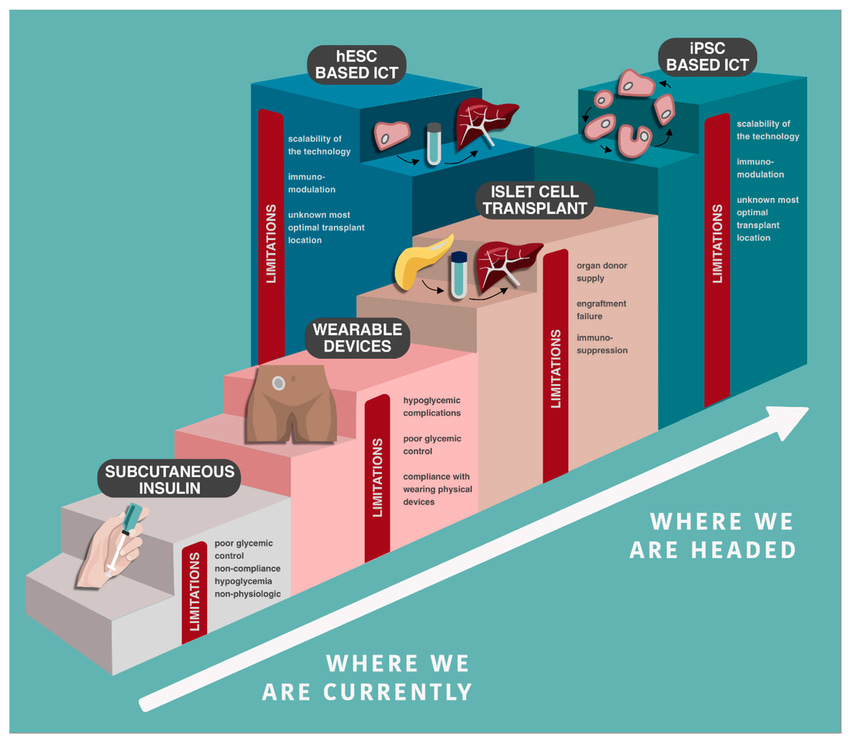
Better measurements can help us develop more effective drugs, personalize dosing so more patients can be treated safely, and build the evidence for more ambitious therapies.
This tree branching also shows the distribution challenge and the distribution opportunity that opens up as you move closer to the frontier. There’s a 3-100x drop in the number of people reached at each rung, at least for now: around 10 million injecting insulin, about 3 million using CGMs, ~300,000 of them on automated pumps, ~hundreds to low thousands who have received islet transplants, and only ~tens of people receiving stem cell therapies in trials. Here again, the design, validation, and distribution of tools matters for uptake.
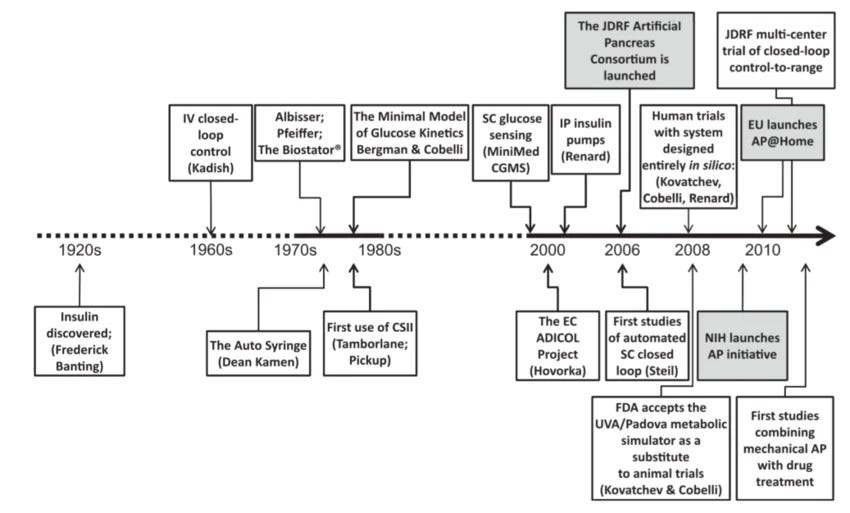
To make concrete “catalyzing” a field and “pulling forward timelines” of new tools for collecting human data, I revisit the ~100 year timeline for this tech tree (Figure 5). Devices were not necessary for discovering and initially developing insulin but were eventually needed for safe, personalized dosing at a population scale. Closed-loop control was first demonstrated in the 1960s but took decades to refine (both hardware and algorithms) and show efficacy in large populations. Learning how to develop other control systems could be enabling us to use efficacious drugs that just need the right guardrails and personalization to work at scale. To ensure we get over any activation barrier, I anticipate we will have to pursue these three arcs, connecting the dots from new sensing chemistry to in vivo work, for at least one area.
(1) Defining targets via roadmaps and physiological modeling
Our protein engineering approach should cover a variety of biomarkers, primarily finding increasing difficulty with larger molecular size and lower concentrations. Those experiments are cheap compared to in vivo testing, which in turn is cheaper than building clinical cases to show utility in a conventional sense. To follow the strongest precedent in clinical knowledge and practice, our initial view is to build solutions in a “nesting doll” style from pancreas to heart/kidney to immune system, and eventually brain-body-behavior systems approaches (Figure 6).
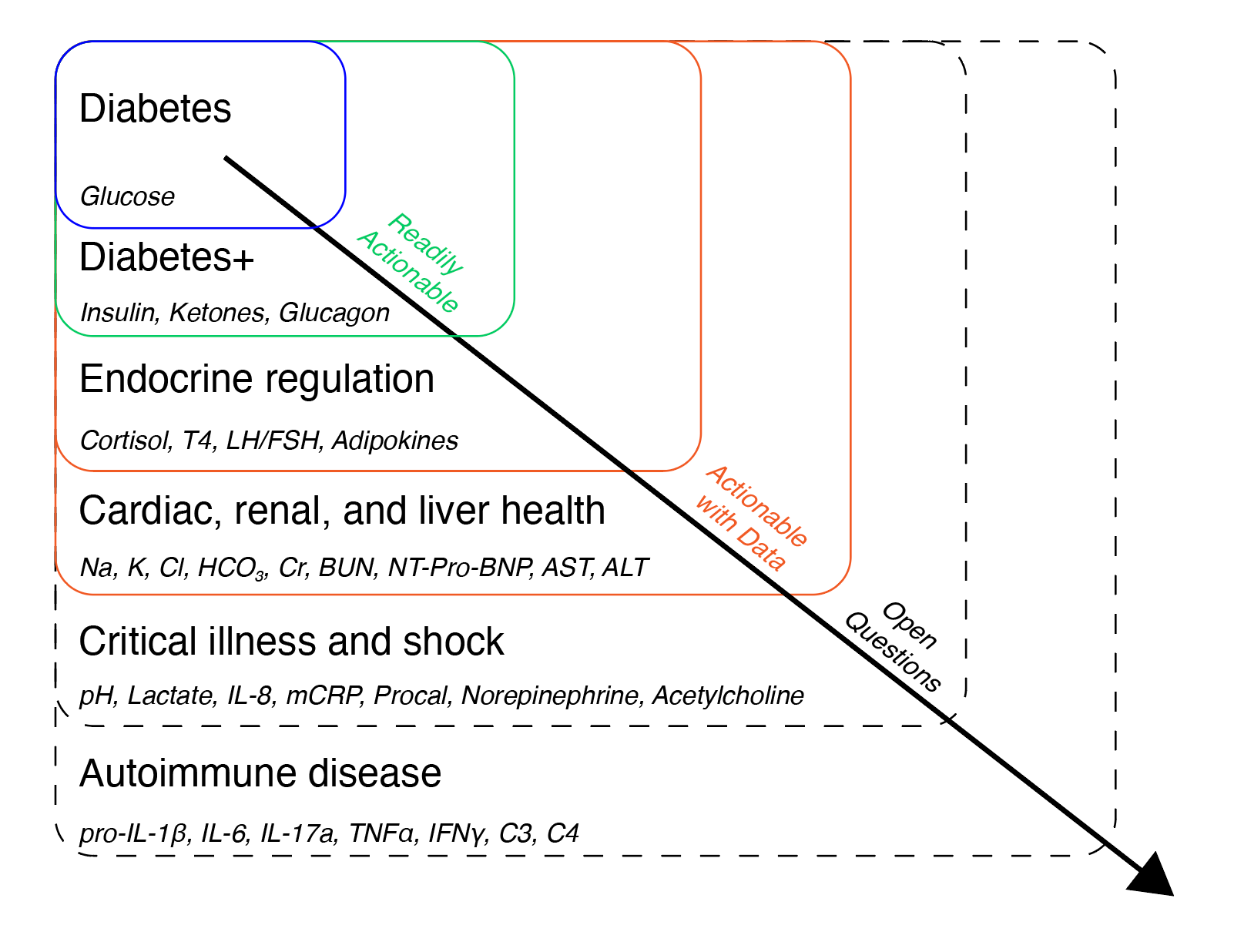
Modeling in particular is underrated in pinning down device constraints for clinical actionability. Years have been spent decreasing the MARD (mean absolute relative difference) of CGMs below 10%. A similar effort may be needed for some metabolites, but other biomarkers, such as immune markers, may simply require ~order of magnitude given their wider dynamic range. We are currently using a combination of machine learning and control theory approaches to this problem, starting with longitudinal CGM data and extending to other areas. Publishing these findings, with clinician input, will serve as beacons to motivate initial investments and set performance benchmarks.
(2) Building bioelectronic testbeds and devices
Continuous monitoring really asks us to imagine schemes to “do biophysics on a device” while playing within human physiological constraints. We must explore new form factors because there is no off-the-shelf solution that meets most, let alone all of these criteria:
Physiological circuits are modulated by ions, metabolites, and hormones with ~min to ~hour time constants. Measurements must have comparable time resolution and tap generalizable solutions for all diffusible biomolecule classes.
Physiological state is multifactorial and clinical trials are costly, so measure many (10s to 1000s) of biomarkers in parallel to make the most of each experiment.
The hardware and/or algorithm must self-diagnose and self-correct against drift (i.e., maintain calibration against fouling and other insults).
To serve brain-body-behavior studies, participants will wear these devices in day-to-day life, ideally, over weeks to months, so the form factor must be miniature (~100s of µm2 to mm2), comfortable, and robust.
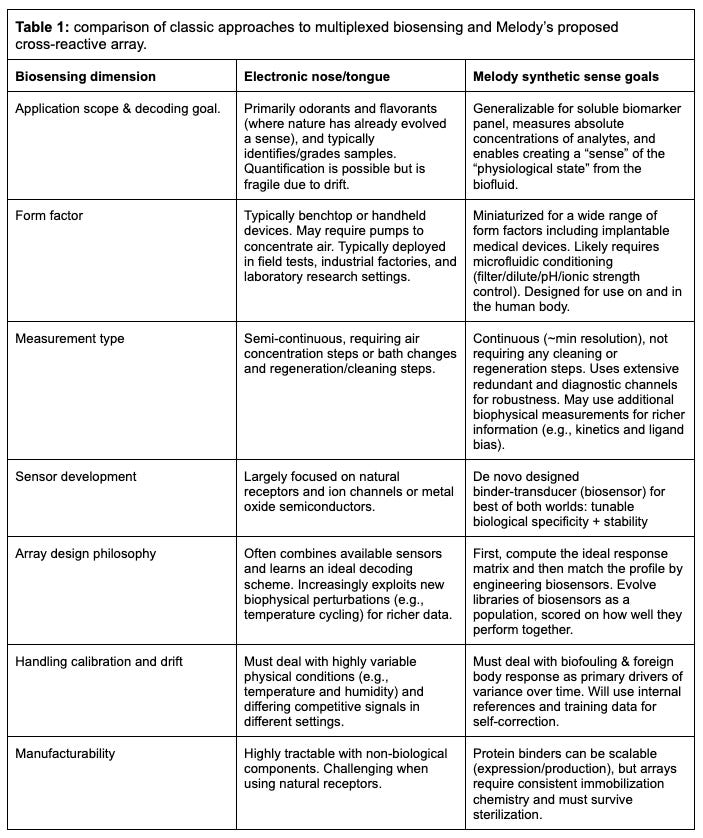
Meeting these constraints in an implantable form factor will require, at a minimum, miniaturizing sensor channels to multiplex in a reasonably sized form factor. While building screening tools for this task, we might as well test another idea: “doing more with less” in sensing more analytes than there are dedicated physical sensors. The electronic nose has long represented an exemplary solution shape for transformative biosensing but it has been hamstrung by reliable tooling and training data. This research direction has been motivated by the observation that the mammalian olfactory system has only ~hundreds of GPCRs to detect odorants and yet discriminates between hundreds of thousands and millions of scents (estimates vary). This system has been exquisitely evolved to perform computation on the relatively sparse inputs even at the input layer neurons (e.g., lateral inhibition) and, of course, in the dedicated olfactory bulb (interestingly, an open question is how it deals with representational drift). But there are critical differences between olfaction and concentration sensing in aqueous solutions in terms of pitfalls and bottlenecks (Table 1). Melody would need to invent new components and processes to deliver such an array.
Table 1: comparison of classic approaches to multiplexed biosensing and Melody’s proposed cross-reactive array.
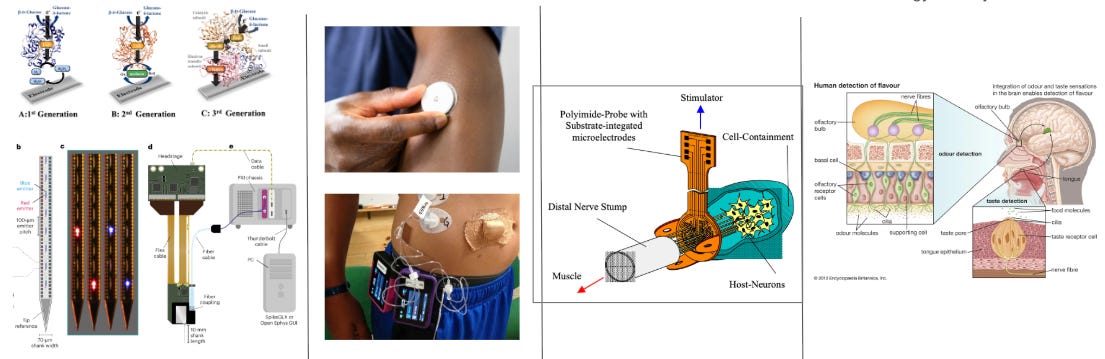
Bioelectronics form factors: Melody will move sequentially through more form factors (Figure 7) based on experimental need and surmounting bottlenecks. We will first generate testbeds which consist of electrode or optical arrays for (a) high-throughput screening to enable protein engineering and to test basic properties of multiplexed arrays like channel cross-talk, mixing heterogeneous samples across the array, and trialing decoding schemes. Then, single or ~few channel devices based on commercially available parts will be used to glean early in vivo performance and limitations.
An inherent problem for implanted devices is eliciting the foreign body response which creates fibrosis and alters device performance and changes the local environment, further introducing fouling and calibration artifacts. One workaround is to design multiple probes with smaller areas and use artificial or living cells as interfaces between the device and tissue. These are biohybrid approaches that may be initially motivated and justified by combating downsides of (2) but also enable richer scientific hypothesis testing (e.g., how cells “decide” simple actions based on complex inputs). In a blue sky but “not-so-far-off” view, these experiments may inform the design of living cell therapies with engineered sensors and actuators to achieve desired behavior, a “seamless cybernetics.”
(3) Engineering proteins for a reusable biosensing platform
Melody’s first goal is to establish which protein-sensing strategies can provide a reusable foundation for new medical devices. We choose proteins as they are nature’s biosensors across the complete breadth of biomarkers. De novo protein design and a growing set of experimental techniques sidestep historic challenges in engineerability. We have previously evolved single biosensors against single biomarker targets, improving sensitivity and specificity. We have found that the binder libraries display modest promiscuity which can be leveraged in screens to detect any one biomarker.
For future cross-reactive arrays, library design can deliver tunable biomarker coverage, co-optimization with decoding algorithms, and stability and manufacturability built in from the outset. Rather than assembling available receptors and hoping a decoder can compensate for their limitations, we compute an ideal response matrix for a given form factor first, then engineer biosensors to match it.
We will test the hypothesis that directed evolution methods can be applied with a fitness criterion for how X number of biosensors work together to discriminate complex mixtures. We will attempt this in two directions: (1) Rational design of a theoretically ideal family of biosensors based on an ideal response matrix for a given set of human biomarkers and (2) Randomized directed evolution at the library level: essentially, create and score biosensors as a “team” in how well they can capture the fingerprint from a biofluid.
Then the challenge lies in producing calibrated electrical or optical signals, requiring “global optimization” of sensing, device integration, and biocompatibility. To address this, we will systematically develop and test three innovative biosensing paradigms. All leverage allostery, where binding in one protein region triggers a structural change in another. This modular design separates and optimizes the key functions of binding and reporting, allowing us to specialize and maximize their performance independently. Furthermore, all three approaches generate their own signal against background (i.e., the electrochemical or optical events are distinct against biological background), which we expect to deliver high-fidelity reporting in complex environments. Each approach has been validated in other fields, suggesting feasibility for translating to medical devices.
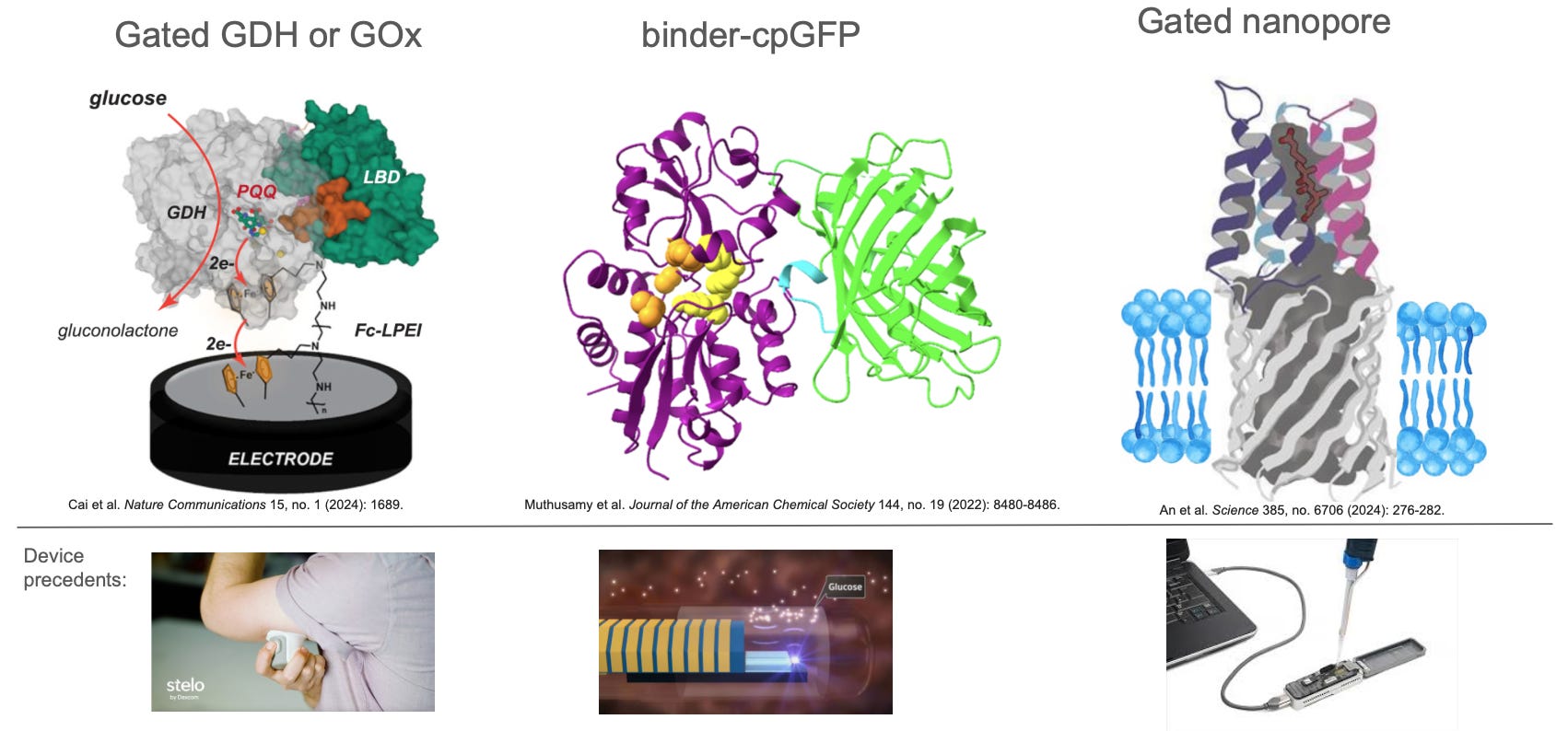
Enzymatic approach: Oxidoreductases like the glucose oxidase used in CGMs can act as biosensors by generating current proportional to the substrate’s concentration.
Advantages: This approach is modestly de-risked through gated enzymes; existing CGMs can readily accommodate allosterically gated enzymes with minimal hardware modifications. Multiplexing is straightforward by designing a device with multiple electrodes bearing unique enzyme variants.
Challenges & solutions: These enzymes can generally only accommodate small molecules, but we will introduce conformational-switching binders to modulate enzyme activity for larger substrates such as proteins based on computational design of binder-enzyme interfaces.
Optical approach: Fluorescent proteins contain a chromophore that can be modulated in brightness and quantum yield by altering its chemical environment (e.g., pH, dielectric constant, and rotational freedom). Furthermore, fluorescent proteins can tolerate circular permutation across their structure, offering facile fusion to binders. These two features have been exploited to create biosensors by fusing conformational-switching proteins via linkers to fluorescent proteins to modulate their optical signals.
Advantages: We recently solved crystal structures to learn the general rule of how the linker inserts itself into GFP to quench the chromophore in the apo state. This strategy has been applied extensively to generate genetically encoded biosensors for use in neuroscience and has been validated for detecting ions, small molecules, peptides, and polypeptides. Many of these reported scaffolds are soluble and sufficiently robust to withstand lyophilization.
Challenges & solutions: This approach has yet to be used in a device for humans. While there is a commercial implantable CGM with a similar form factor (Senseonics Eversense), it is based on an abiotic sensing polymer not suitable for most biomarkers, has only one channel, and is proprietary. The challenge lies in immobilizing the biosensors and placing them in a miniaturized, implantable fluorometer. We will use a simple fluorometer based on LEDs, thin film filters, and hydrogels that can be implanted as a self-contained device or worn with external electronics.
Nanopore approach: transmembrane pores gated by fused binders, mimicking ion channels.
Advantages: Nanopores offer potentially large versatility, accommodating biomarkers ranging from small ions to large proteins. They have been used in benchtop devices such as DNA sequencers, de-risking their manufacturability. Bulk analyte sensing relies on collective nanopore responses, simplifying the requirements for this application compared with DNA sequencing.
Challenges & solutions: Naturally occurring ion channels are known to require chaperones to fold and a particular lipid bilayer composition to function. We must ensure that our own nanopores do not suffer from this environmental sensitivity and fragility in handling to ensure robust performance after device fabrication. We will focus on synthetic nanopores with binder fusions for allosteric gating, stabilized by semipermeable membranes, covalent linkers, or hydrogels. Nanopore devices require optimization of microwell structures and electrode geometry and material in order to integrate with CMOS chips. Nanopores face the greatest engineering challenges, but represent the greatest potential in terms of substrate scope.
Methods output: an all-evolvable biosensing platform
Experimental throughput is especially important when a biosensor’s performance depends on its scheme and surroundings (immobilization, neighboring sensors, and living tissue can all change its behavior). Each iteration of our platform should best accelerate the next. We want to take the power of libraries encoded by DNA and directed evolution and apply it up and down our platform.
We anticipate developing a core technical capability: active learning for the directed evolution of bioelectronics and biohybrid devices. Our approach turns each level of the stack into a genetically encodable, directed evolution problem where the reward function is greater observability and control of the sample. Each level of the stack can be evolved (assuming they can be physically linked to the protein) to generate variety and then in an integrated instrument to select for performance:
10-10 to 10-9 m: conformation and state-switching proteins with suitable kinetics - measure conformational changes via spectroscopic ruler methods. In particular, intrinsic aromatic residue fluorescence or minimal unnatural amino acids can be encoded to enable intra-molecular FRET in single molecule or population modes.
10-8 to 10-7 m: bio-material interface - test biosensors across encapsulation or support structure materials. Exploit functional biophysical tests, pull-down assays, and cross-linking + mass spectrometry (e.g., what lipid mixture allows a channel to survive).
10-6 to 10-5 m: array evolution - ask what set of biosensors cooperatively best capture some chemical complexity (i.e., testing many of the candidates from 10-8 - 10-7 level in a cohort).
10-4 to 10-3 m: array-cell interface - initially express sensors (e.g., binder with optical readout) in the tissue for preliminary studies to motivate device development (e.g., “does measuring acetylcholine really matter here?”) and then move the sensor from cell to device.
~10-2 m: tissue integration - the biohybrid interface may be patterned on various geometries of leads to access deeper into tissues or sweep through larger volumes. Biocompatible materials can be patterned to guide the branching of sentinel cells probing into the tissue.
Working with us for common sensing
Our mission is to catalyze a broader research community around continuous molecular monitoring. No single organization has the resources to fabricate their own devices and explore every promising clinical application of this emerging technology. We aim to be the central hub for benchmarking approaches, generating new devices, and, eventually, producing small batches for clinical research.
To maximize public health impact, we will distribute our biosensors and ready-to-use devices to life scientists and clinical researchers for research purposes. We draw inspiration from and will adapt protocols from Addgene, which streamlined the banking and sharing of plasmids, and Neuropixels, which provides robust, plug-and-play electrophysiology probes for neuroscience.
We will deposit all engineered protein constructs, including biosensor proteins, binder scaffolds, and reporter fusions, with Addgene for broad distribution to the research community. To further lower the barrier to entry for new users, we will publish standardized protocols covering device setup, calibration, data collection, and troubleshooting.
Open data for algorithm development: Beyond distributing physical devices, we imagine that the data generated by multiplexed biosensor arrays are a valuable resource for the broader scientific community, particularly for researchers developing machine learning algorithms for biosensing, neuroscience, and medical devices. We are gathering support to create a public data repository for biosensor characterization data, particularly in biofluids and devices. These often include control experiments, negative data, and methods details that are not systematically reported in the literature. These resources will build the foundation for a future of abundant, performant bioelectronics, serving basic science and human health alike.
Contact: We welcome feedback on our open science efforts and invite those interested in collaborations in both developing and applying new biosensors and devices to reach out to info@melodyfro.org.
Acknowledgments
We have many, many friends and colleagues to thank for their support throughout the years:
Editing and feedback on this piece: Joseph Fridman.
Melody team and former and current affiliates contributing to research: David Garrett, Chris Marotta, Miranda George, Daniel Wagenaar, Eryney Marrogi, Ben Andrew, Anish Sarma, Daniel Li, and Sophia Gershaft.
Convergent Research & our community: Adam Marblestone, Anastasia Gamick, Kristin Ellis, Mary Wang, Avery Holland, Dennis Dougherty, and the FRO community.
Friends of the project, workshop attendees, and contributors of feedback on planning: Milan Cvitkovic, Tom Kalil, Ales Flidr, Tatyana Dobreva, David Brown, James Phillips, Sarah Constantin, Dana Lewis, Henry Lester, Wei Gao, Sheng Xu, Anne Andrews, Josh Clemente, Jenna Hua, Daniel Goodwin, Rohit Chitale, David Klonoff, and Michael Snyder.